Cybersecurity Essentials for Local Columbia SMBs

Adam Quan is the President of Columbia IT Solutions, an award-winning provider of managed IT services to over 200 businesses and nonprofits in the Southeast.
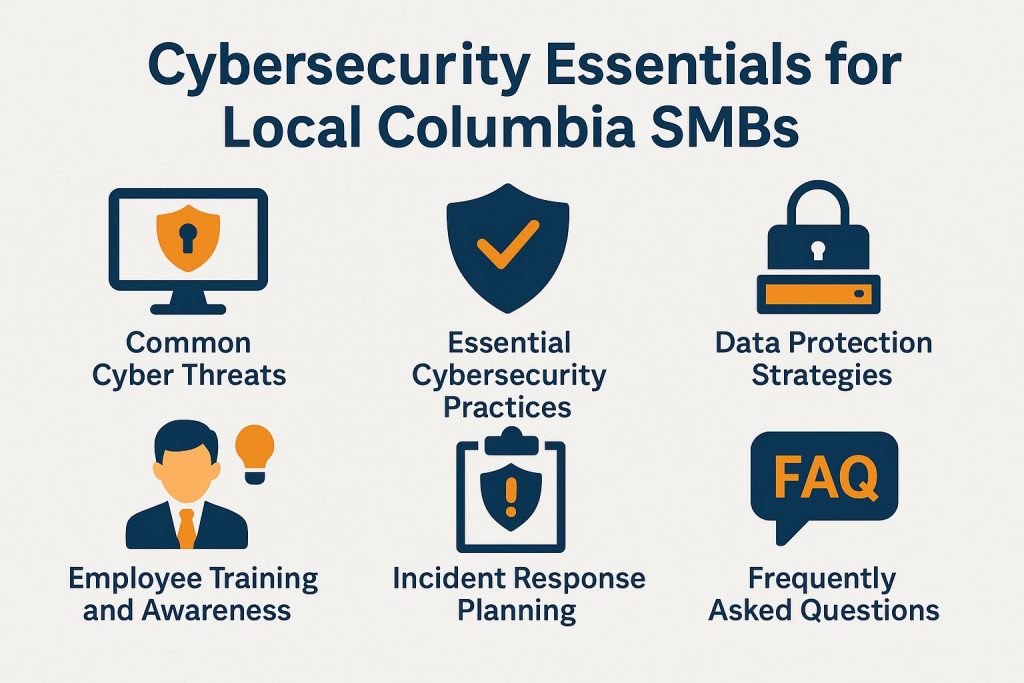
Understanding common cyber threats such as phishing and ransomware is essential for protecting sensitive business data. This guide on small business Cybersecurity in Columbia explores key practices every small and mid-sized business should adopt — including robust data protection strategies, employee training, and effective incident response planning. By implementing these measures, local businesses can strengthen their defenses, reduce risk, and navigate today’s digital landscape with greater confidence and security.
Common Cyber Threats
Understanding common cyber threats is crucial for effective risk management, as these vulnerabilities can greatly affect an organization’s integrity and reputation. For those seeking a deeper dive into these challenges, our comprehensive guide on Cybersecurity Threats & Solutions for Modern Businesses, supported by cybersecurity services in Columbia, offers valuable insights.

Phishing Attacks
Phishing attacks cause 90% of data breaches. They exploit human error through deceptive emails and fake websites. This shows the need for strong cybersecurity training. Organizations should conduct phishing simulations to prepare employees.
For instance, in a notable whaling incident, a fraudster successfully impersonated a CEO and directed an employee to transfer funds to a fraudulent account.
To mitigate these risks, organizations should implement comprehensive training programs such as KnowBe4, which research indicates can reduce susceptibility to phishing by up to 80%. Incorporating threat intelligence and cybersecurity awareness programs in training can further enhance security. Additionally, conducting regular simulations and providing updates on emerging phishing tactics will help ensure that employees remain vigilant against evolving threats.
Ransomware
Ransomware attacks increased by 300% in 2021. Damages are projected to exceed $20 billion globally in 2023. These attacks impact businesses of all sizes. Implementing endpoint security and network monitoring strengthens defenses against such cyber threats. A notable example is the Colonial Pipeline incident in May 2021. This attack disrupted fuel supplies in the Eastern United States and highlighted the serious effects on infrastructure.
To mitigate the risk of such attacks, organizations are advised to implement multi-layered defenses.
These defenses should include the utilization of endpoint protection tools, such as Acronis, which starts at $69 per year for regular backups and enhances cloud security through secure backup solutions. Additionally, organizations should establish firewalls and provide employees with training on phishing awareness.
Regular software updates and vulnerability assessments are essential. They can significantly reduce the risks of ransomware and strengthen cybersecurity frameworks.
Essential Cybersecurity Practices
Essential cybersecurity practices help organizations defend against evolving threats. They ensure compliance with industry standards.
Organizations should prioritize multi-factor authentication (MFA). It can stop 99.9% of account compromise attacks. Effective access control and identity management are crucial components of cybersecurity strategies.
Additionally, establishing a routine for regular updates of software and systems is crucial for patching vulnerabilities; tools such as WSUS for Windows or Yum for Linux environments can be particularly beneficial in this regard.
Investing in employee training programs is also essential, as human error accounts for 95% of cybersecurity breaches. Comprehensive security awareness and cybersecurity consultation are vital for establishing secure communication practices. Curious about common cybersecurity threats and how to protect against them? This insight is crucial for reducing risks effectively.
By using these practices, organizations can reduce risks. The average cost of a data breach is currently $4.24 million.
Data Protection Strategies
Implementing effective data protection strategies is essential for safeguarding sensitive information from unauthorized access and breaches. To bolster these strategies, it’s crucial to be aware of the top cybersecurity threats facing businesses and how to prevent them.

Secure Backup Solutions
Backup solutions must be robust. They must be reliable. Over 60% of small and medium-sized businesses fail to recover after severe data loss.
- For example, Backblaze offers affordable cloud storage at $6 per month, making it accessible for small business Cybersecurity in Columbia.
- Acronis, priced at $69 per year, provides comprehensive backup features along with advanced security protocols.
- In contrast, Veeam targets larger enterprises, requiring a significant investment of $1,200 per year, but excels in rapid recovery times and detailed customization options.
Disaster recovery and business continuity planning are critical. Evaluate backup solutions carefully.
To develop a solid data protection plan, integrate a mix of solutions. Consider your budget and recovery needs.
Employee Training and Awareness
Employee training is crucial for cybersecurity. Organizations see a 70% reduction in incidents after implementing awareness programs. Cybersecurity certifications and online safety protocols strengthen cyber resilience.
To establish effective training, use platforms like KnowBe4 and SANS. KnowBe4 offers courses starting at $30 per user, emphasizing real-world scenarios, while SANS offers comprehensive sessions that explore technical aspects in greater detail.
Monitor the effectiveness of training programs. Use metrics like user engagement and phishing simulation results, and follow-up assessments.
Furthermore, fostering a culture of cyber hygiene is essential; organizations that prioritize continuous education and maintain open communication regarding threats often experience significant cultural shifts, leading to enhanced overall security awareness and compliance with cybersecurity regulations. For an extensive analysis of this trend, our comprehensive study on cybersecurity threats and solutions examines effective strategies.
Incident Response and Security Incidents Planning
A strong incident response plan reduces recovery time from a breach by up to 80%. This is vital for resilience. Threat detection and security audits are key components of these plans. To develop an effective incident response plan, organizations should incorporate the following key components:
- Preparation is crucial. Teams must be trained and equipped with essential tools, like PagerDuty for incident management and cyber insurance to mitigate business risks.
- Detection involves actively monitoring systems for potential breaches; tools like Splunk can assist in identifying anomalies, contributing to effective intrusion detection and security solutions.
- Following detection, containment is critical to isolate affected systems, which should be followed by eradication to ensure complete removal of threats.
- The recovery phase should include restoring systems and conducting a review of the incident to enhance future responses. Worth exploring: Effective IT Disaster Recovery Planning for Business Resilience.
- Regular drills are essential to refine the response approach, ensuring that the team is adequately prepared when a real incident occurs.
Frequently Asked Questions
What are key cybersecurity measures for Columbia SMBs?
Cybersecurity essentials for local Columbia SMBs include implementing strong passwords, regularly updating software, and training employees on security protocols.
Why is cybersecurity important for local Columbia SMBs?
Cybersecurity is vital for Columbia SMBs. They are targeted by cybercriminals due to limited resources. Compliance and secure coding are imperative.
How can local Columbia SMBs protect their data?
Columbia SMBs can protect their data. Regular backups, firewalls, antivirus software, and encryption are key.
What are some common cyber threats that local Columbia SMBs should be aware of?
Some common cyber threats that local Columbia SMBs should be aware of include phishing scams, malware attacks, and ransomware.
What should local Columbia SMBs do in the event of a cybersecurity breach?
In case of a breach, immediately disconnect from the internet. Contain the attack and contact a cybersecurity professional.
How can local Columbia SMBs stay updated on the latest cybersecurity trends?
Local Columbia SMBs can stay updated on cybersecurity trends. They can join industry organizations, attend workshops and conferences, and read reputable sources on cybersecurity news and best practices.