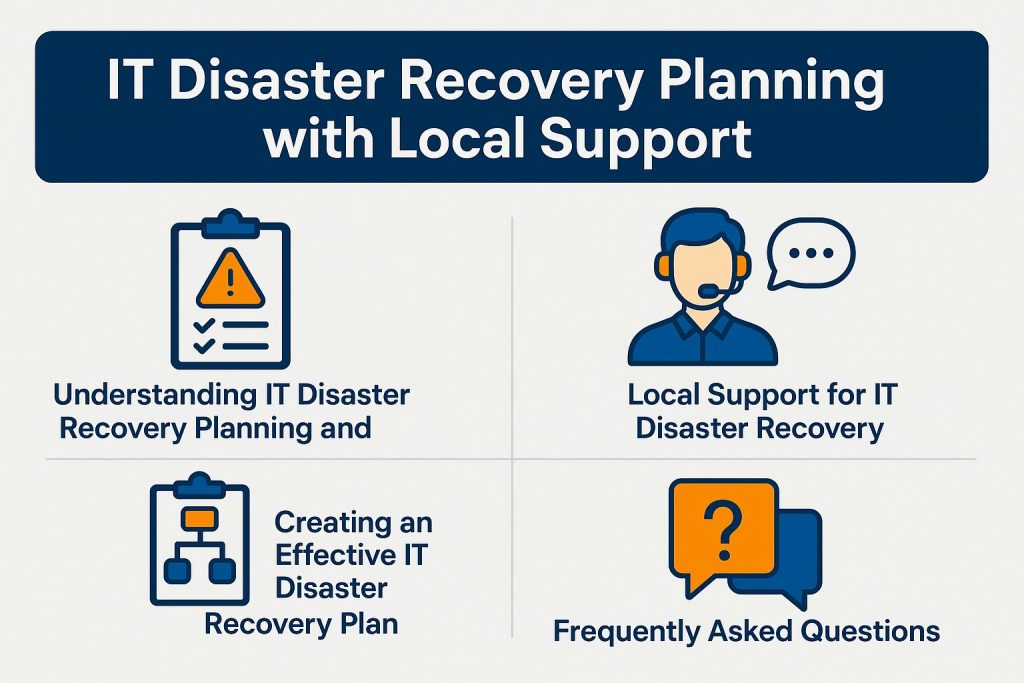
IT Disaster Recovery Planning for Columbia Businesses: Navigating Midlands Risks

Adam Quan is the President of Columbia IT Solutions, an award-winning provider of managed IT services to over 200 businesses and nonprofits in the Southeast.

When operating a business in Columbia, relying on technology to sustain operations necessitates robust it disaster recovery planning. The threat of flooding or sudden power loss can feel overwhelming, but effective preparation safeguards your data and keeps operations running smoothly when disruptions occur.
Key Insights
Local Risk Exposure – Columbia businesses face distinct challenges from regional flooding and frequent power disruptions; proactive planning is essential to mitigate costly downtime and data loss caused by these specific local vulnerabilities.
Defining Objectives – Establishing clear Recovery Time Objectives (RTO) and Recovery Point Objectives (RPO) helps organizations quantify acceptable downtime and data loss, guiding the prioritization of IT recovery efforts for critical applications and systems.
Comprehensive Documentation – Effective recovery strategies depend on detailed inventories of hardware, software, and data, along with documented recovery procedures and communication plans that function independently of standard network infrastructure.
Layered Recovery Strategies – Modern approaches combine cloud-based solutions, offsite backups, and on-premises infrastructure to create resilient layered strategies that address different failure scenarios, protecting against regional environmental risks common in the Midlands.
Continuous Validation – Regular testing, including tabletop exercises and full-scale recovery simulations, is crucial for validating that recovery procedures work as documented and for identifying any gaps before an actual disaster occurs, ensuring continuous improvement.
This guide will explore how Columbia’s specific risk profile influences the practical steps businesses can take to enhance their emergency preparedness and strengthen their IT recovery capabilities.
Understanding IT Disaster Recovery Planning
What is an IT Disaster Recovery Plan? An IT Disaster Recovery Plan (IT DRP) outlines the strategies and processes an organization implements to restore critical systems and data following disruptive events. For Columbia businesses, this includes proactively addressing unique challenges such as regional flooding and power disruptions. Developing an IT Disaster Recovery Plan involves several key steps, including establishing clear objectives for recovery.
Recovery Time Objective (RTO) defines the maximum tolerable downtime for a critical application or system. Conversely, the Recovery Point Objective (RPO) specifies the maximum amount of data an organization can afford to lose. These metrics help determine how much data can your organization afford to lose and how long can you go without this data. By setting these objectives, businesses can accurately assess how quickly recovery must occur to protect their operations and minimize financial impact.
Every Organization Needs an IT DR Plan? Absolutely. While the scale and scope may vary, every organization that relies on technology for its core functions needs an IT DRP. It is not a matter of ‘if’ a disaster will occur, but ‘when’. Ignoring the need for such a plan can lead to significant financial losses, reputational damage, and even business failure. A well-crafted plan provides a roadmap for continuity.

A crucial first step in any disaster recovery initiative is conducting a Business Impact Analysis (BIA). This process identifies critical applications and systems, assessing the financial and operational impact of their downtime. The BIA helps answer, what needs to be recovered? and in what order should systems be restored? By prioritizing critical applications, resources can be allocated effectively during recovery.
Another fundamental aspect is risk analysis and assessment. This involves identifying potential threats (like flooding or cyberattacks) and evaluating their likelihood and potential impact. For Columbia, this assessment must heavily weigh environmental factors specific to the Midlands, which often means considering local weather patterns and infrastructure vulnerabilities.
Key Components of a Robust IT DRP
Developing an effective IT Disaster Recovery Plan requires systematic documentation of people, processes, and technology dependencies. Organizations must identify every system supporting daily operations and understand its contribution to revenue generation. This holistic view provides a clear picture of what requires protection during disruptive events such as floods and power outages.
Establishing Roles and Responsibilities
Clearly defined roles and responsibilities are paramount during a crisis. The plan must specify who is responsible for each step of the recovery process. This includes identifying key personnel, outlining their duties during activation, and establishing chain of command. Communication protocols, which must function independently of standard network infrastructure, are also critical. These protocols enable decision-makers to coordinate recovery efforts even when email and phone systems are down.
What to Include in Your Plan: Comprehensive Documentation
Your IT DRP should include detailed inventories of all essential hardware, software licenses, network configurations, and vendor contact lists. This documentation proves invaluable when primary systems become unavailable. It should contain step-by-step recovery procedures for every system, detailing specific commands, configuration file locations, and validation checks. For example, knowing the exact steps to restore a critical database or business application saves precious time during an actual disaster. Maintaining current account numbers, support tier information, and escalation procedures for emergency hardware replacements is also vital. This ensures a swift response when equipment is damaged or backup power capacity is exceeded.
Data Backup Strategies and Procedures
Effective data backup is the cornerstone of any disaster recovery strategy. Without reliable backups, recovery is impossible. Organizations need to implement comprehensive backup strategies that include regular, automated backups of all critical data. These backups should be stored offsite, ideally in geographically diverse locations, to protect against localized disasters affecting the primary site and its immediate surroundings. Businesses in the Midlands should consider storage solutions outside of flood zones and areas prone to widespread power outages. Ensuring data integrity and the ability to restore from backups are frequent concerns, which is why regular testing of backup data is essential. Learn more about data backup and recovery solutions.
Midlands Risk Profile and Tailored Recovery Strategies
Understanding regional threat patterns helps organizations prioritize their IT disaster recovery planning investments based on actual exposure. Columbia businesses face a distinct combination of environmental risks, primarily flooding and power disruptions, that dictate their infrastructure operations and business continuity strategies.
Columbia’s geography, particularly its proximity to major river systems, makes it vulnerable to flooding during heavy rainfall. Reviewing FEMA flood zone maps for facility locations and identifying backup sites outside these areas is a critical preventative measure. Installing elevated server racks and waterproof barriers in lower-level facilities can provide physical protection. Many local businesses choose secondary facilities at higher elevations. Partnering with colocation providers outside the immediate flood risk areas for emergency server migration is also a smart strategy.

Power disruptions are also a common concern, especially during summer thunderstorms and winter ice storms. Mapping historical outage durations helps determine appropriate Uninterruptible Power Supply (UPS) and generator capacities. Furthermore, calculating fuel reserves for extended outages and establishing priority agreements with fuel suppliers are crucial steps for maintaining operations during widespread power failures. Regular testing of backup power systems is vital to ensure they function reliably when needed most, supporting 24/7 IT monitoring in Columbia.
Phases of IT Disaster Recovery
An IT disaster recovery plan typically involves three main phases:
- Activation – This initial phase involves detecting the disaster, assessing its impact, and formally declaring a disaster. The pre-defined roles and responsibilities come into play here, and immediate communication protocols are activated.
- Recovery – During this phase, the actual processes to restore critical systems and data begin. This includes executing recovery procedures, restoring from backups, reconfiguring hardware, and bringing applications back online in the order prioritized by the BIA. The goals here are to meet the RTOs for critical systems.
- Reconstitution – Once critical systems are operational, the reconstitution phase focuses on full restoration, verification, and returning to normal operations. This includes comprehensive testing to ensure data integrity and system functionality, post-incident reviews, and updating the DRP based on lessons learned.
IT Disaster Recovery vs. Business Continuity
While often used interchangeably, IT disaster recovery and business continuity are distinct but interconnected concepts. IT Disaster Recovery vs. Business Continuity is a common point of confusion. IT disaster recovery focuses specifically on the recovery of IT infrastructure and systems after a disruption. Its goal is to minimize IT downtime and restore technological operations to predefined service levels.
Business continuity, however, is a broader concept. It encompasses the entire organization’s ability to maintain essential functions during and after a significant disruption. This includes not just IT, but also facilities, personnel, critical business processes, supply chains, and communications. An effective IT DRP is a critical component of an overarching business continuity plan, ensuring that the technology framework exists to support continued business operations.
A comprehensive business continuity plan would consider scenarios where IT systems are fully operational, but other aspects of the business are affected. For example, if a physical office becomes inaccessible due to flooding, the business continuity plan would address how employees work remotely, how customer service continues, and how essential goods or services are still delivered, even if IT is technically functional. Therefore, an IT DRP is a tactical plan, while business continuity is a strategic framework.

Testing, Maintenance, and Continuous Improvement
Regular testing ensures that recovery procedures work as documented and identifies potential gaps before a real disaster strikes. Columbia businesses must consistently validate their IT disaster recovery planning processes to address unique environmental risks. Stakeholders benefit significantly when exercises highlight weaknesses in documentation or response protocols.
Quarterly tabletop exercises allow teams to review recovery scenarios without disrupting live operations. These sessions use current documentation to simulate floods or extended outages common in the Midlands. Participants practice critical decision-making processes to protect business continuity during emergencies. Additionally, annual full-scale recovery tests restore systems from backup to measure actual recovery times against established targets. These exercises confirm that disaster recovery procedures function effectively under realistic conditions. Lessons learned from each test are integrated directly into plan improvements.
Avoiding common disaster recovery mistakes involves moving beyond simple backup creation to include comprehensive testing. Many organizations discover flaws during a real event simply because they neglected to test. Furthermore, continuous improvement and maintenance are essential. Recovery plans are living documents. They must be reviewed and updated regularly to reflect changes in IT infrastructure, business processes, and the threat landscape. Proactive IT monitoring tools also maintain audit trails of all recovery testing, supporting compliance requirements and informing continuous improvement efforts. Organizations track testing standards across multiple cycles to keep their plans current and effective.
Ready to Secure Your Business?
Don’t wait for a disaster to highlight the gaps in your IT recovery plan. Our Columbia IT team specializes in building and testing disaster recovery strategies tailored to Midlands businesses, ensuring you are prepared before an outage hits.
Frequently Asked Questions
What is an IT Disaster Recovery Plan?
An IT Disaster Recovery Plan (IT DRP) is a documented strategy detailing how a business will restore its technology infrastructure and data after a disruptive event. It includes procedures for data backup, system recovery, and maintaining operational functionality.
How quickly must recovery occur to protect the business?
The speed of recovery is defined by your Recovery Time Objective (RTO). This metric specifies the maximum acceptable duration of downtime for a critical application or system, helping to prioritize recovery efforts and allocate resources effectively.
What needs to be recovered, and in what order should systems be restored?
A Business Impact Analysis (BIA) identifies critical applications and data that need recovery, prioritizing them based on their impact on business operations. Systems directly affecting revenue or essential customer services are typically restored first, followed by less critical functions.
Who is responsible for each step of the IT disaster recovery process?
Roles and responsibilities are explicitly defined within the IT Disaster Recovery Plan. This ensures that every team member knows their specific duties during crisis activation, recovery, and reconstitution phases, including designated communication protocols.
How often should IT Disaster Recovery Plans be tested in Columbia?
Columbia businesses should test their IT disaster recovery plans at least biannually. This verifies effective responses to simulated flooding or extended power outages, ensuring staff proficiency and identifying any necessary updates to the plan.